Welcome the more stable work of the 19 th National Congress, and lift the people’s steady happiness.
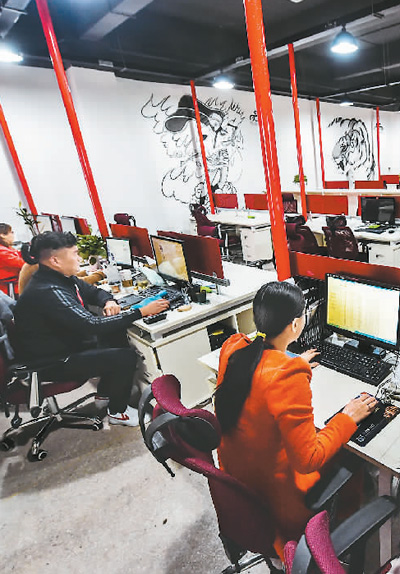
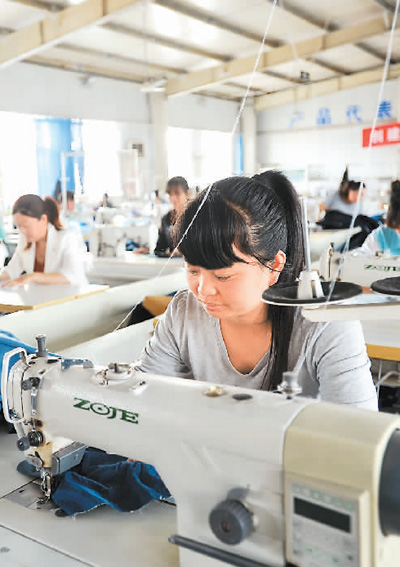
A poverty alleviation micro-factory was set up in Xuanhua District, Zhangjiakou City, Hebei Province to revitalize rural idle labor resources and drive more than 10,000 people to find jobs at home. Photo by Chen Xiaodong (People’s Vision)

In the past five years, the employment situation in China has remained stable and achieved remarkable results under the background of economic growth and shifting gears, and the total working-age population is still huge. According to the 2017 World Competitiveness Report released by IMD, China’s "employment" performance ranks first among 63 major economies in the world. The Organization for Economic Cooperation and Development (OECD) issued a report saying that "productivity growth and high-level employment have become the main driving forces for China’s economic growth".
The employment of key groups is progressing steadily, the vitality of entrepreneurship and innovation is fully flowing, and the employment service guarantee is improving day by day. "More stable work" is supporting the people’s stable happiness.
The employment level has been rising all the way in the past five years.
7.95 million, which is the number of college graduates nationwide in 2017, 300,000 more than in 2016. To solve the employment problem of college graduates, which is increasing year by year, we need reasonable policy guidance, feasible scheme measures and multi-party cooperative efforts.
In this year’s employment process, Jin Wei, a student from the School of Mechanical Engineering of Tianjin University of Technology, has no anxiety about job hunting. Last summer vacation, he participated in the special vocational ability training of industrial robots organized by Tianjin Vocational Skills Public Training Center for free. He was taken by a technology company and signed an employment agreement in advance. "With so many projects paving the way, our college students will make their dreams come true as long as they work hard." Jin Wei said.
"The rural areas in China, at least the rural areas I am experiencing now, are really fertile soil." Xu Jumin, who has been a college student village official for three years in Miaofengshan Town, Mentougou District, Beijing, is also very touched. He also has a deeper understanding of the ardent expectation of the Supreme Leader General Secretary that young students go to the grassroots level. "Rural students need to display their strength, and it is easier for college students to get a platform in rural areas."
The employment experience of Jin Wei and Xu Jumin is the epitome of millions of graduates successfully entering the society. All kinds of recruitment double elections, real-name registration system registration for unemployed college graduates leaving school is fully covered. The special post plan for college student village officials and rural teachers, the "three supports and one support" plan, and the grassroots project of college students’ voluntary service in the western region provide a broader platform for college graduates. Under the escort of various policies, it is more and more convenient for college graduates to find jobs, choose jobs more and more calmly, and the graduation season is getting warmer. According to statistics, although the number of college graduates has increased year by year in recent years, from 6.8 million in 2012 to 7.95 million in 2017, the employment level of college graduates has always remained stable, the initial employment rate has remained stable at over 70%, and the overall employment rate at the end of the year has remained above 90%.
In addition to the employment of young students, the employment of the poor and other people with employment difficulties also attracts attention. According to the statistics of Ministry of Human Resources and Social Security, from 2013 to 2016, a total of 22.38 million unemployed people in cities and towns were re-employed, and 6.99 million people with employment difficulties were employed, helping 249,000 of the 220,000 zero-employment families to find jobs, thus realizing the dynamic clearing of zero-employment families.
With the employment level of key groups rising all the way, the overall employment performance in China is gratifying. In the past five years, the number of new jobs in China’s cities and towns has remained above 12 million every year, and the cumulative number of new jobs in the past five years has exceeded 65 million, which is about equal to the total population of Britain.
With the continuous expansion of employment scale, increasingly optimized employment structure, remarkable progress in coordinating urban and rural employment, and more reasonable regional employment pattern, the International Labour Organization also praised China’s employment policy, believing that China’s experience is "the best combination of modern employment concept, the experience of other countries in the world and the reality of China".
Entrepreneurial innovation contributes to new employment opportunities
The overall popularity of China’s employment report card can not be separated from the strong drive of "mass entrepreneurship and innovation".
Youth is the main force of entrepreneurial innovation. In May 2013, when the Supreme Leader participated in the theme group day activities of China Aerospace Science and Technology Corporation, he pointed out that it is necessary to pay more attention to the wishes of young people, help them develop, support their entrepreneurship, and build a broader stage for their practice and innovation. According to the 2016 China University Student Entrepreneurship Report released by China Renmin University, nearly 90% of college students have considered starting a business, nearly 20% have a strong entrepreneurial intention, and nearly 30% have entrepreneurial experience.
In Dongguan, Guangdong Province, a one-time venture reward of 5,000 yuan and a venture guarantee loan of 100,000 yuan solved the start-up capital problem of Chen Weicong, the founder of Totoro Technology Co., Ltd. "Our entrepreneurial road has gone more steadily." Chen Weicong said with emotion.
In addition to financial support, the state’s emphasis on entrepreneurship education has also given these new entrepreneurial forces more confidence. Entrepreneurship education is listed as a compulsory course in colleges and universities, a demonstration base for mass entrepreneurship is built, and a talent pool of 10,000 outstanding innovation and entrepreneurship instructors in China & HELIP is initially built; … With the help of many policies and measures, the entrepreneurial situation of college graduates is gratifying. According to the Employment Report of China College Students released by MyCOS Research Institute and China Academy of Social Sciences, in the past five years, the proportion of college graduates in China who start businesses after graduation has increased from 1.6% in 2011 to 3.0% in 2017, nearly doubling. Based on the total number of 7.95 million fresh graduates in 2017, the number of entrepreneurial college students exceeds 200,000.
Returnee entrepreneurship is also the backbone of entrepreneurial innovation. Behind Feng Haichao, a group of returnees, various preferential policies of the country have contributed greatly. "Zero-cost entrepreneurship is a gift to start-ups." In 2013, Yang Zibin, who returned from the United States, came up with the idea of starting a business. After applying to Beijing (Haidian) Overseas Students Pioneer Park, he successfully settled in the centralized office area and enjoyed the free work station, and the fees for enterprise registration, legal consultation and entrepreneurship counseling were all free. In the past five years, 347 pioneer parks for overseas students have been built nationwide, with more than 27,000 enterprises entering the park, 79,000 returned overseas students starting businesses in the park, and tens of millions of young returnees like Yang Zibin have been relieved of worries and "packed lightly".
Gather sand into a tower, and the explosion of entrepreneurial craze has also brought new changes. In recent years, the newly registered enterprises in China have experienced a "spurt" growth. Since 2013, the annual growth rate of newly registered enterprises has remained above 20%. In 2016, nearly 15,000 new enterprises were created daily, an increase of 3,000 over the previous year, which contributed nearly 40% to the new employment in cities and towns in the same period. The vitality of entrepreneurial innovation is fully flowing, and the multiplier effect of entrepreneurship driving employment is constantly emerging.
Security is improving day by day and stabilizing employment.
In the past five years, while doing everything possible to expand employment in China, the employment service and security mechanism are also improving day by day.
The "streamline administration, delegate power, strengthen regulation and improve services" reform has been further promoted, and the employment efficiency has been greatly improved. From June 21st to 23rd, more than 150 vivid application cases showed the effect of informatization construction in the era of "internet plus" on promoting employment at the first national exhibition of innovative application of informatization in human society. For this, Sun Wanying, a college student, knows this very well. From applying for job-seeking and entrepreneurship subsidies to 800 yuan subsidies being credited to the bank account, she didn’t take a step on campus to do this. "I gave the materials to the counselor and got the money in a few days. It was really efficient." Now that she has been successfully employed, she is full of smiles.
Vocational skills training continues to exert strength, and everyone strives for a skill. In 2013, when the supreme leader visited Tianjin, he stressed the need to "do a good job in vocational skills training and improve the employment service system". Gu Wei, a disabled boy who lives in baixia district, Nanjing, is the beneficiary of vocational skills training. After attending the local high-tech training course for the disabled, his photography skills have been greatly improved. Today, as a photographer, he has become famous in the local area.
In the past five years, the major actions of vocational skills education have been one after another: launching special activities to revitalize skills, promoting the reform and innovation of technical colleges, starting a new apprenticeship system for enterprises, building a lifelong vocational training system for workers, carrying out more than 97 million government-subsidized vocational training, formulating more than 10 skilled personnel policies in four categories, building 476 training bases for high-skilled personnel and nearly 600 national skill master studios … … Continuous investment has brought fruitful results: by the end of 2015, there were 165 million skilled workers in China, accounting for 41% of urban employees, and the employment path of ordinary people is getting wider and wider.
Labor relations are guaranteed, and there is no worry about employment. The old security horse in Tongzhou District of Beijing is very happy recently. "After signing the collective contract, I feel more practical." In recent years, Tongzhou District has made great efforts to implement the labor contract system for small enterprises, and the old horse is one of the beneficiaries. By the end of 2016, the collective contract signing rate of enterprises with more than 100 employees in Tongzhou District reached 97%, the collective contract coverage rate of small and micro enterprises was 90%, and the industrial collective contract covered nearly 15,000 employees.
Nationwide, such actions to protect employment rights and interests are also in full swing. In view of the abuse of labor dispatch, the state has taken special actions to guide enterprises to achieve a smooth transition in employment methods and protect the legitimate rights and interests of the majority of labor dispatch workers; In view of the problem of wage arrears for migrant workers, various localities have continuously improved their policies and generally established a wage guarantee system in the construction industry. Some areas have also established an emergency working capital system. Labor and social security supervision institutions at all levels have also further unblocked channels for reporting and complaining, strengthened daily inspections and various inspectors, and severely cracked down on criminal acts such as refusing to pay labor remuneration. Various policies and measures have been taken in a multi-pronged manner, and the people have got jobs and stabilized, and the "rice bowl" is getting stronger and stronger.
Li Zhen Liu Jingyuan Drawing: Pan Xutao